
Serving humanity as a form of worship
At the heart of Sikh life lies seva—selfless service. Seva is not just charity; it is a spiritual discipline, a way of remembering Waheguru by serving His creation. Guru Nanak Dev Ji said: “Only that service which is done without thought of reward is of any value.”
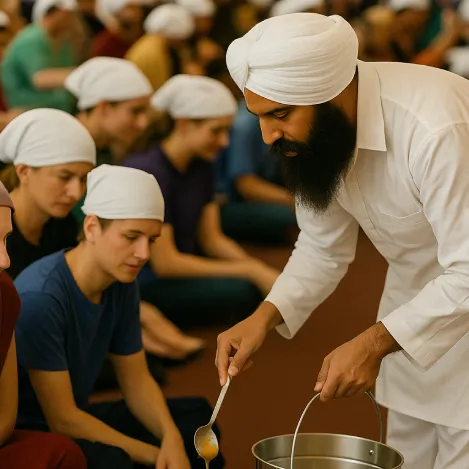
In a Gurudwara, seva takes many forms. One might see a child arranging shoes, a grandmother rolling rotis in the Langar hall, or a young man cleaning the floors after prayer. Each act, though ordinary, becomes extraordinary when performed in devotion. Through seva, pride dissolves, and humility blossoms.
But seva does not end at the Gurudwara doors. Across the world, Sikhs have carried seva into refugee camps, disaster zones, and inner-city shelters. During the floods in Kerala, earthquakes in Nepal, and even protests like those in Delhi, Sikh volunteers set up Langars, distributed aid, and offered shelter. The world took note, with headlines calling Sikh seva “the gold standard of compassion.”
Dasvandh, the practice of giving one-tenth of one’s income to serve others, is an extension of seva. This principle ensures that every Sikh contributes to the common good, reinforcing that wealth is not to be hoarded but shared. Through dasvandh, schools, hospitals, and community projects have flourished.
Seva is the Sikh way of living prayer. It transforms worship from ritual into reality, making every act of kindness a hymn, every moment of service a meditation.